
Founder, Product Manager, Developer | 2026
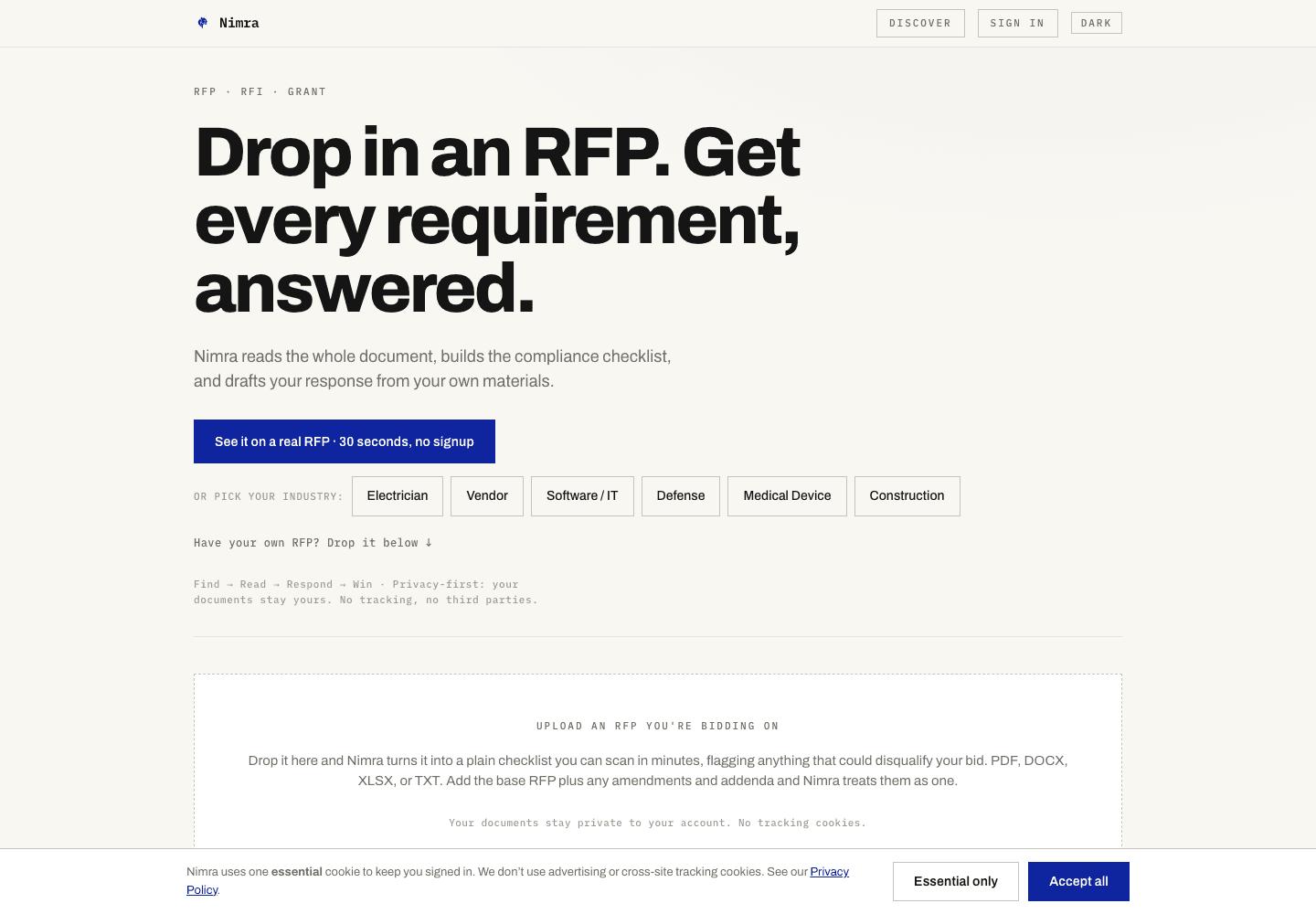
Nimra.ai is my AI tool for RFPs, RFIs, and grants. The product promise is deliberately practical: drop in an RFP, get every requirement identified, turn the document into a compliance checklist, and draft responses from your own company materials.
I first developed Nimra as a Product School "AI for Product Management" class project, then refined the architecture and product workflow through Carnegie Mellon's Agentic AI course. That evolution changed the product from a simple "AI reads RFPs for me" idea into a more serious workflow for reading documents, extracting obligations, routing uncertainty, and preserving institutional knowledge.
The name Nimra comes from the Arabic and Hebrew word for a female leopard. I liked the iconography because it matched the product's posture: fast, agile, focused, and strong enough to help a small bidder carry an opportunity much bigger than itself. And the name is short, phonetic, and available.
The Problem
RFP response work is high-stakes and repetitive in the most exhausting way. A team receives a long PDF, DOCX, XLSX, or collection of addenda. Someone has to read every line, find every requirement, identify disqualifiers, assign owners, draft answers, and make sure the response says something the company can actually stand behind.
The problem is not merely writing. The deeper problem is that the company's answers are scattered across old proposals, product documentation, security questionnaires, implementation notes, pricing assumptions, legal language, and people's memories.
That makes RFPs a knowledge-management problem disguised as a sales workflow.
The Product Thesis
Nimra is built around a simple product thesis:
The best RFP tool does not start by writing. It starts by reading.
The system needs to understand the whole document before it drafts anything useful. That means extracting requirements, building a plain-language checklist, flagging anything that could disqualify a bid, and only then helping the user generate answers from source material they trust.
The live product emphasizes that sequence:
- Read the whole RFP, RFI, or grant.
- Pull out every requirement.
- Build a checklist the user can scan in minutes.
- Treat the base RFP, amendments, and addenda as one package.
- Draft responses from the user's own capabilities and materials.
- Keep documents private to the user's account.
That is much more valuable than a blank text box with an eager model waiting inside it.
Why AI Fits This Workflow
RFPs are a strong AI use case because the work combines repetition with context.
Companies get asked similar questions again and again: security, implementation timelines, integrations, reporting, support, pricing assumptions, data handling, and roadmap posture. But each answer still depends on the customer, the industry, the procurement language, and the level of commitment the company is willing to make.
Nimra's job is to compress the tedious parts without erasing human judgment. It can classify questions, retrieve related prior answers, draft a response, and identify where a human should slow down.
The human still owns the final answer. That boundary is important because RFPs are a bad place for confident nonsense.
Agentic AI Lessons
Carnegie Mellon's Agentic AI course helped sharpen the architecture behind Nimra.
The useful framing was not "ask the model to answer this." It was a workflow with state, tools, and handoffs:
- Parse the uploaded files.
- Extract requirements and disqualifiers.
- Classify each requirement by topic and risk.
- Retrieve trusted company material.
- Draft an answer.
- Flag weak source coverage or risky commitments.
- Route the answer for human review.
- Save approved language for the next response.
That loop makes the product more durable. Each completed RFP should improve the knowledge base and make the next one easier.
Product Decisions
Several product decisions came directly from the shape of the problem.
Requirements before prose. If the tool misses a mandatory requirement, a polished answer does not matter. Extraction and checklisting are first-class features, not setup steps.
Privacy as a product feature. RFP documents often contain sensitive procurement language, customer details, pricing context, or internal response material. Many commercial RFPs are invitation only, and a seller would be insane to invite more competitors into an RFP bidding situatio. Nimra's positioning is privacy-first: documents stay tied to the user's account, with no advertising or cross-site tracking.
Industry samples. The homepage lets visitors preview a real RFP flow without signup and choose sample verticals like electrician, vendor, software/IT, defense, medical device, and construction. This lowers the activation barrier while keeping the product grounded in concrete buyer contexts.
Energy RFP discovery. Nimra also included a public-energy-RFP digest concept: new electrical, grid, solar, storage, and EV-charging solicitations summarized with deadlines and disqualifier watch-outs. This connects the RFP response workflow back to the markets I know best. This has since expanded to other verticals as customers have requested it.
What I Learned
Nimra reinforced a lesson I keep finding in product work: boring workflows can hide excellent products.
RFPs are not glamorous. They are spreadsheets, PDFs, attachments, amendments, stakeholder reviews, and late nights before a deadline. But the pain is specific. The stakes are real. The workflow has natural repetition. The output matters to revenue. And existing solutions are so, so expensive. That is a good place for AI to help the little guy be competitive.
The product challenge is not to make AI sound impressive. It is to make the organization faster, clearer, and more consistent when it answers the questions that decide whether a deal moves forward. That is what I am building with Nimra.ai.