

Founder, Product Manager, Developer | 2026
Gachi is a lightweight feature-voting tool I built over a weekend because I needed a specific kind of product signal and the available solutions were far too heavy for the job.
The name comes from the Korean word for "together". This captured what I wanted from the product: not just votes, but buy-in, shared enthusiasm, and a clearer sense of whether a feature had the room with it. (Not to mention the name was short, friendly, and phonetic. And available.)
The use case was simple: I am on a call with a large group, I need a hot take on a feature, and I want to know whether the room is actually moved by what they saw.
I needed a tool simpler than a five-week research project, procurement-grade survey platform, elaborate workshop suite and all the rest of the heavy duty tools out there. I wanted a purpose built tool. Here are the features, here is the scale, vote now, show me the distribution, and let me export the results.
The Problem
Product managers often need fast qualitative signal from a group. The question is not always "what should we build?" Sometimes the question is more primal:
Did this feature turn heads?
I use Gachi with my sales team to get a read on whether a feature would "wow" in a demo. If the team is excited, that matters. Sales people live in customer objections, buying signals, competitive displacement, and demo-room silence. They have a sharp ear for whether something will land. In EV fleet charging, some customers are totally new to EV charging, and are making buying decisions with a great deal of uncertainty. Visuals that tell a story well with software designed to help them goes a long way to building confidence in InCharge.
If the vote is flat, that also matters. It does not automatically mean the feature is bad. Some features are not stunners. Some are critical plumbing. Some only matter to one persona. Some need a better story. Some need to be jettisoned.
The important thing is to make the reaction visible.
The Product
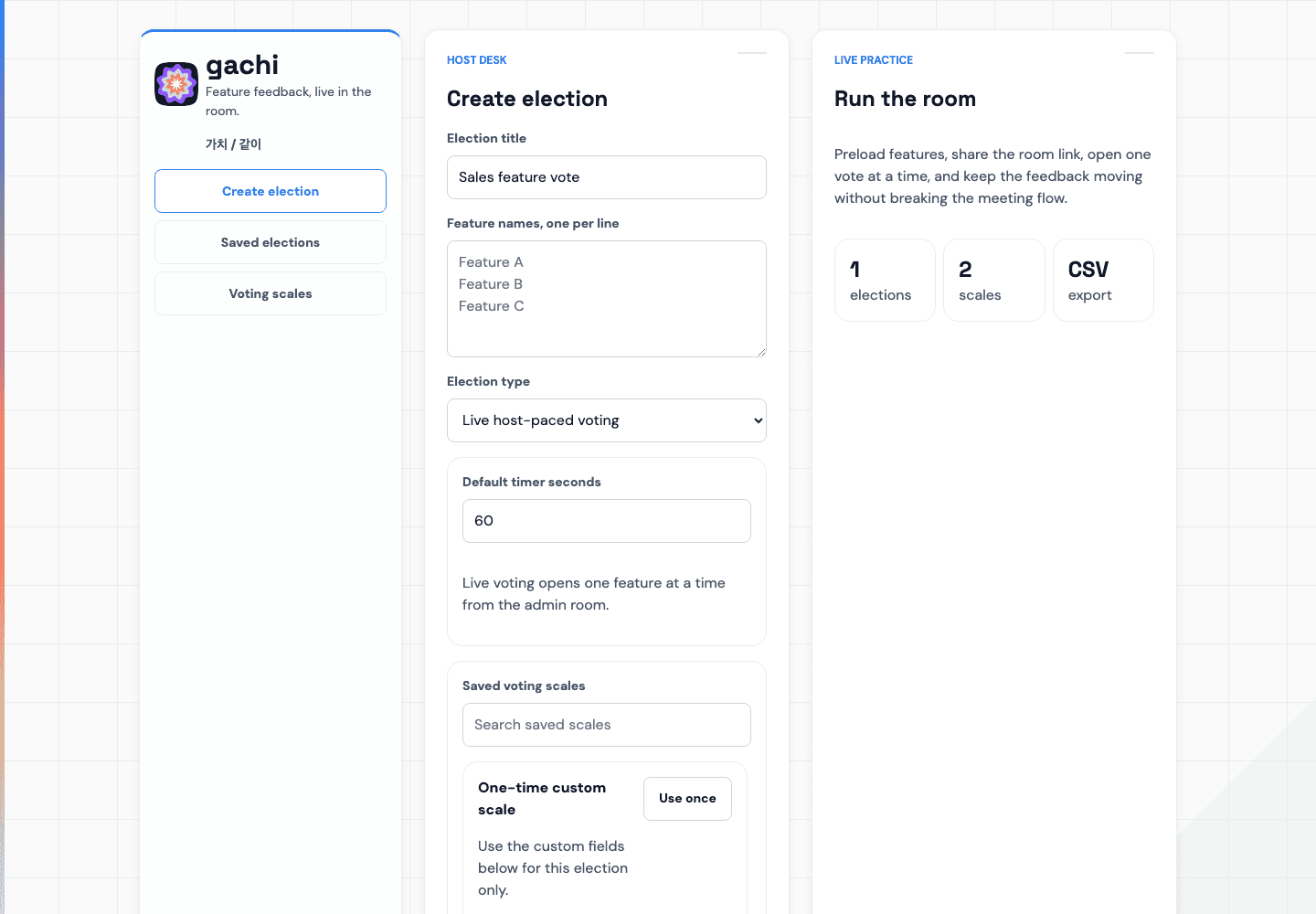
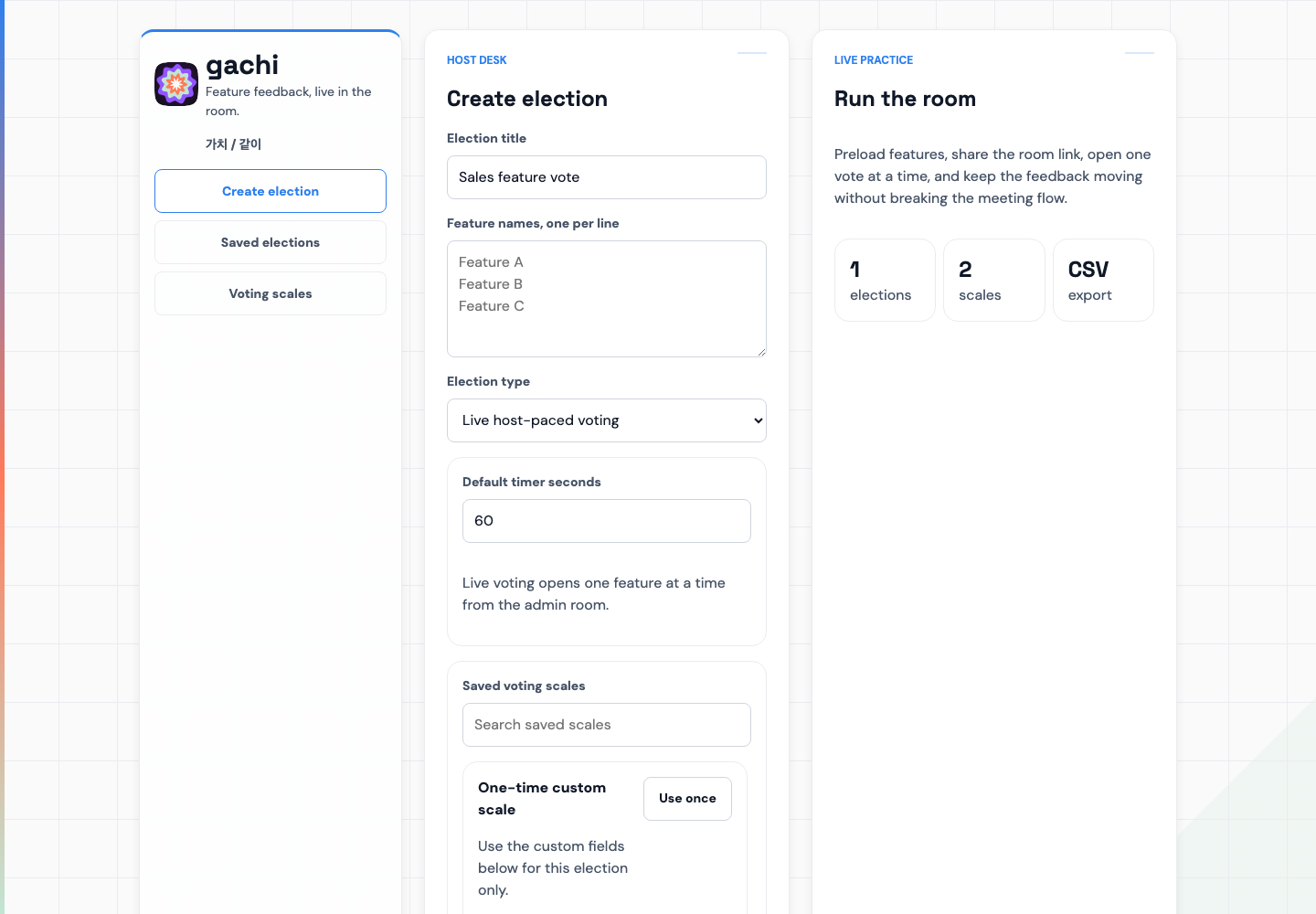
Gachi supports live and async feature votes. A host creates an election, adds feature names, chooses or defines a voting scale, shares a participant link, and opens one feature at a time.
The default scale is tuned to sales impact:
- Not relevant
- Nice to have
- Table stakes
- Strong differentiator
- Deal maker
That language matters because it pulls the room out of vague preference and toward deal impact. A feature can be useful without being a deal maker. A feature can be table stakes without being exciting. Those distinctions help a product manager avoid mistaking silence for failure or excitement for strategic necessity.
What I Built
The first version focused on the narrow workflow:
- Create a feature vote.
- Support live host-paced voting.
- Support async voting windows.
- Let participants join with a name and emoji.
- Open one feature at a time.
- Track vote status in the room.
- Save voting scales for reuse.
- Export average, median, and distribution to CSV.
It is intentionally small. That is the point. Gachi solves one meeting problem cleanly.
Product Lesson
Gachi taught me again that a useful product does not need to be broad. It needs to be sharp. I can only take a few minutes in our sales all-hands meetings so the tool needs to be dead simple.
The best version of this tool is not a generic prioritization platform. It helps a product manager capture the temperature of a group at the moment when the reaction is fresh.
That signal then feeds into more serious prioritization work I did with Tuki. A feature that wows the sales team still needs feasibility, viability, business case, dependency mapping, and roadmap context. But desirability is not imaginary just because it is qualitative. Gachi captures that spark before the meeting moves on.